We get asked this at least once a week, usually by a school administrator, a property manager, or a business owner who just watched a news report about a break-in. The question is always some version of the same thing: will this film stop a bullet?
The honest answer is no. Security window film is not bulletproof. Any installer who tells you otherwise is either confused about the product or willing to sell you something on a promise it cannot keep, and in a security conversation that is the most expensive kind of mistake you can make.
That answer usually leads to a much better conversation, because once the bulletproof myth is off the table, people start asking what the film does do. And what it does do is significant enough that it protects schools, government buildings, storefronts and homes across Delaware and Maryland every day. It just does it through a completely different mechanism than most people assume.
The Short Answer, and Why the Word Bulletproof Causes Trouble
Bulletproof is not really a technical term. The industry term is bullet resistant, and the distinction matters. Nothing is proof against every projectile. Ballistic products are rated to resist specific ammunition, fired a specific number of times, from a specific distance. Change the round and you change the outcome.
Bullet resistant glazing is a thick laminated assembly, often an inch or more, built from layers of glass and polycarbonate. It is heavy, it is expensive, it usually requires a reinforced frame to carry the weight, and it is installed as a replacement for the glass you already have. It is a glazing system, not a film.
Security window film is a thin polyester laminate, measured in thousandths of an inch, applied to the surface of glass you already own. It is not built to absorb the energy of a bullet and it will not do so. What it is built to do is hold broken glass together, and that turns out to be a genuinely valuable thing.
What Security Window Film Is Actually Built to Do
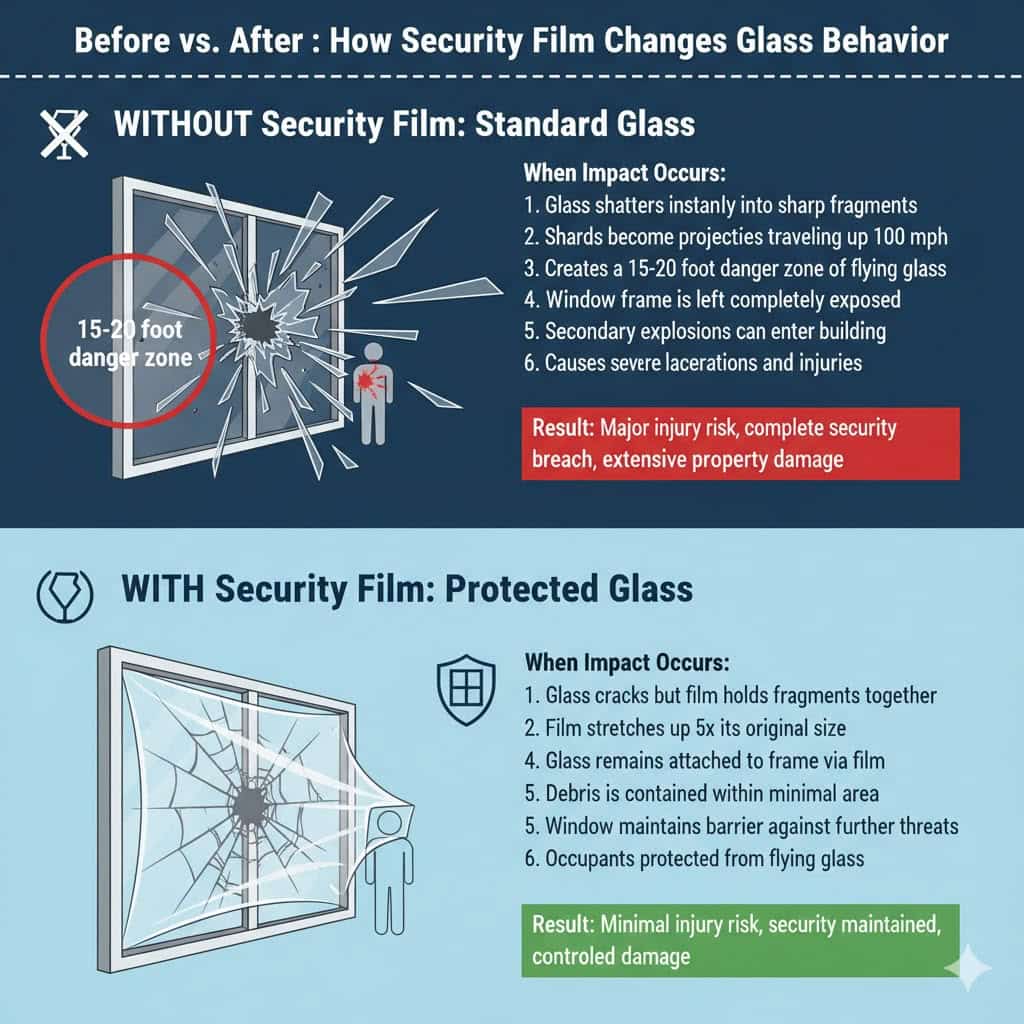
Ordinary window glass fails in a specific way. When it breaks, it stops being a barrier instantly. The pane leaves the frame, the opening is clear, and anything on the other side has an open door. That failure happens in under a second.
Security film changes what happens after the break. The glass still breaks. It just does not leave. The film holds the fragments in a single sheet that stays in the opening, and someone trying to get through has to keep working at it, repeatedly, loudly, in full view.
That is the whole product in one sentence: security film buys time and makes noise. In security planning, time and noise are what everything else depends on. Time for an alarm to register and a response to start. Time for people inside to move somewhere safer and lock a door. Time for an opportunist to decide the job is taking too long and leave.
Most break-ins are not sophisticated. Somebody picks up a rock, a brick, a landscaping paver or a crowbar and swings once at the most obvious pane of glass. A single swing on untreated glass is the whole job. On filmed glass, that same swing produces a spiderwebbed pane that is still sitting in the frame, and the person now has a decision to make out in the open.
Four Myths We Hear Constantly
Myth 1: Thicker Film Means Bullet Resistance
Thicker security film does perform better against impact and forced entry, and there is a real difference between a light film and a heavy one. But the gap between the heaviest security film available and true ballistic glazing is not a matter of degree. They are different categories of product doing different physics. You cannot stack enough film to cross that gap, and you should be skeptical of anyone who implies you can.
Myth 2: The Film Is What Holds the Glass in the Frame
This is the most consequential misunderstanding in the entire category, and it is the one that separates a real security installation from a decorative one.
Film bonds to the glass. It does not bond to the frame. Apply film alone and you have converted a pane that shatters into a pane that stays in one piece, but that intact sheet can still be pushed out of the frame as a unit. The attacker now has a clean opening and not even any broken glass to climb over.
The fix is an attachment system: a structural sealant or a mechanical batten that anchors the filmed glass to the window frame itself. Now the whole assembly has to be defeated rather than just popped out. Attachment is what turns security film from a glass treatment into a barrier, and it is the line item that gets quietly dropped from cheap quotes.
If you are comparing bids and one is noticeably lower than the others, check whether it includes attachment. That single line usually explains the whole difference.
Myth 3: Security Film and Privacy Tint Are the Same Thing
They are not, and confusing them leads people to believe they already have protection they do not have.
A sun control film is engineered to manage heat, glare and ultraviolet light. It is thin, because thin is what it needs to be to do that job well. A decorative or privacy film is engineered to obscure a sightline or change the look of a pane. Neither is built for impact, and neither will hold a broken pane together in any meaningful way.
Security films are usually clear, which is exactly why people miss them. A properly specified security installation on a storefront is invisible from the sidewalk. That is a feature. You do not want to advertise which windows are hardened and which are not.
You can combine functions. There are films that deliver both solar performance and impact protection in one layer, and that is often the right answer for a south-facing storefront that needs to solve heat and security at the same time. But you have to specify it deliberately. It does not happen by accident.
Myth 4: If It Is Not Bulletproof, It Is Not Worth It
This one comes up in budget meetings, and it collapses as soon as you look at what actually happens to buildings.
The overwhelming majority of glass-related incidents at a school, a clinic, a government office or a retail unit are not shootings. They are smash-and-grab burglaries, vandalism, attempted forced entry, storm debris and accidental impact. Security film addresses every one of those directly. Holding out for a ballistic solution you cannot afford, and therefore installing nothing at all, leaves you exposed to the events that are far more likely to happen.
There is also a whole-building math problem. Ballistic glazing is typically specified for a handful of specific positions, such as a reception window or a single controlled entry point. Security film can be applied across every ground-floor opening in a building for a fraction of what glazing a few of them would cost. Coverage has a value that a small number of very hard points does not provide.
What Security Film Genuinely Protects Against
Setting the bulletproof question aside, here is the real list.
Smash and Grab Burglary
The classic scenario: one impact, reach through, take what is visible, leave. The entire model depends on the glass failing on the first hit. Filmed and attached glass breaks that model, because the intruder is now committed to a sustained, noisy assault on a window that is still standing.
Forced Entry and Intrusion Delay
For a determined intruder with tools, film is a delay measure rather than a stop. That is the correct way to think about it and the way security professionals already do. Physical security is measured in the time a barrier buys before detection and response arrive. Film adds meaningful minutes at the most commonly attacked point in any building.
Storm and Windborne Debris
Delaware and Maryland get coastal storm systems and the debris that comes with them. When a branch or a piece of somebody else’s roof hits a window, the danger is not only the opening it leaves. It is the glass traveling into the room. Film holds that glass in place. For buildings without impact-rated glazing, this is often the most practical protection available.
Blast Mitigation
In an explosive event, flying glass is historically a leading cause of injury. This is precisely why federal facility guidance has pushed window film and attachment systems for decades. It is also the application where the attachment system is not optional. We cover the federal side of this in our guide to meeting GSA requirements with security window film.
Everyday Accidental Impact
Less dramatic and more common than any of the above. A cart into a glass partition, a ball through a gym window, a slip into a glass door. Film keeps that glass from becoming a room full of edges, which is why so much of our school and daycare work is really a safety glazing project rather than a security one.
Bullet Resistant Glazing vs Security Film, Side by Side
These two products get compared as though you must choose one. In practice, buildings that need both use both, in different places.
- Bullet resistant glazing replaces the glass entirely, is rated against specific ammunition, adds significant weight, often requires frame reinforcement, and is priced for targeted use at a small number of critical openings.
- Security window film upgrades glass you already own, installs without replacing the glazing, adds no meaningful weight, is invisible when clear, and is economical enough to cover an entire elevation.
A realistic layered specification for a school or a government building looks like ballistic glazing at the single controlled entry vestibule, security film with attachment across every ground-floor classroom and office window, and standard glazing above the reachable line. That is a coherent plan. Ballistic glass everywhere is not a plan, it is a budget that will never be approved.
The Products We Install and Why
We have been a 3M Authorized Platinum Dealer since long before most of the current crop of installers existed, and the security line is where that relationship matters most, because this is the category where a bad product choice stays invisible until the day it fails.
3M Scotchshield Safety and Security Film is the core of most of our commercial work. It comes in a range of thicknesses so the specification can be matched to the actual threat and the actual budget, and it is available in clear versions as well as versions that also deliver solar performance.
C-Bond takes a different approach. It is a nanotechnology treatment applied to the glass that strengthens the glass itself, and it can be used together with film to raise the performance of the whole assembly. It is worth a conversation on projects where the existing glazing is the weak point.
And again, the attachment system. Whichever film goes on, the anchoring method is what determines whether you bought a barrier or a very good anti-shatter treatment. Both are worth having. They are not the same purchase, and you should know which one you are approving.
How to Spec Security Film for a Real Building
A good specification starts with the building, not with the product sheet.
- Name the threat. Burglary after hours, daytime intrusion, storm debris and blast are four different problems. They lead to different films and different attachment methods.
- Walk the elevation. Identify the reachable openings, the ones concealed behind landscaping, and the ones nobody can see from a road. Those are the ones that get attacked.
- Check the glazing you already have. Annealed, tempered, laminated and insulated units all behave differently, and some films are not appropriate on some units. This is a real technical constraint and it is why a site visit is not a formality.
- Decide on attachment openly. Wet glaze, mechanical batten, or none. Put it in writing so every bid is quoting the same scope.
- Ask what happens to the glazing warranty. Film on the wrong glass type can affect it. A dealer who has done this work will raise the issue before you do.
If you are early in the process and mostly trying to understand what a project like this involves, our breakdown of what drives security window film cost covers the variables that actually move a number, and our comparison of shatter proof versus shatter resistant untangles another pair of terms that get used interchangeably and should not be.
Where Film Fits in a Layered Security Plan
Film is one layer. It works because of what surrounds it.
The delay film provides is only worth something if somebody knows the attempt is happening, which means alarms and monitoring. The noise it forces is only worth something if there is a person to hear it or a camera pointed at it. The time it buys is only worth something if there is a lock, a door, or a procedure that uses that time.
We are careful about this with schools in particular, because film gets sold as a standalone answer and it should not be. It is the layer that makes the rest of the plan work. We wrote about how that plays out for districts in our piece on security window film for Maryland schools, and about the practical side of a district project in our look at Baltimore school window film upgrades.
Questions Worth Asking Any Installer
- Does this quote include an attachment system, and which type?
- What is the film thickness, and why that one for my building?
- Have you verified my glass type on site before quoting?
- Are your installers manufacturer trained and certified on this product line?
- Can you show me comparable work in my area?
- Are you carrying current workers compensation and liability certificates?
An installer who answers all six comfortably is one you can work with. An installer who leads with the word bulletproof is one to walk away from.
Frequently Asked Questions
Will security window film stop a bullet?
No. Security window film is not a ballistic product and is not rated as one. It is designed to hold broken glass together to delay forced entry and reduce injury from flying glass. Stopping projectiles requires bullet resistant glazing, which is a laminated glass and polycarbonate assembly that replaces the existing glass.
How long does security film delay a break-in?
It depends on the film, the attachment system, the glass underneath, and how determined and equipped the intruder is. There is no single honest number, which is why we talk about the delay concept rather than quoting a stopwatch figure. The meaningful comparison is against untreated glass, which offers essentially no delay at all.
Can security film go on any window?
Most, but not all. Glass type, unit construction and orientation all affect which films are appropriate. Insulated units in particular need attention, because the wrong film on the wrong unit can create thermal stress. This is exactly what a site survey is for.
Is security film visible once installed?
Clear security films are essentially invisible once cured. If you want solar performance or privacy as well, those versions will change the appearance of the glass, which is a specification choice rather than a side effect.
Does security film help with heat and glare?
Only if you choose a combination product. Standard clear security film is built for impact and does very little for solar heat. Films that do both exist and are frequently the right call for storefronts and west-facing elevations.
Talk to Someone Who Will Give You the Real Answer
We have been installing window film out of Newark, Delaware since 1989. We are family run and woman owned, and we work across Delaware, Maryland, southern Pennsylvania and New Jersey on everything from a single storefront to a multi-building school district project.
If somebody has told you a film is bulletproof, we would rather have the conversation that corrects that than let you make a decision on it. And if what you actually need is delay, coverage, and glass that stays in the frame, that is a conversation we can have with real specifications behind it.
Look at our full safety and security window film line, or request a quote and we will come look at your building.