
Security window film costs $8 to $15 per square foot installed for most homes and businesses, which works out to about $150 to $300 for a single window and $2,000 to $3,750 for a typical 3-bedroom home. Adding a frame attachment system adds roughly $3 to $5 per square foot. Large institutional projects price lower per square foot because of volume, starting around $7. Those are 2026 estimates for Delaware, Maryland, New Jersey, and Washington DC, and an on-site survey may move them.
What follows is the detail behind that range for homeowners, business owners, and school and government facility managers: what moves the price, what you get for it, and what film cannot do at any price.
Security Window Film Cost at a Glance
|
What you are pricing |
Typical size |
Estimated installed cost (2026, DE / MD / DC) |
|---|---|---|
|
Single window |
15 to 20 sq ft |
$150 to $300 |
|
Sliding glass door |
30 to 40 sq ft |
$300 to $600 |
|
Typical 3-bedroom home |
200 to 250 sq ft |
$2,000 to $3,750 |
|
Commercial storefront bay |
60 to 100 sq ft |
$600 to $1,500 |
|
School wing or single building |
1,000 to 5,000 sq ft |
$9 to $12 per sq ft |
|
District-wide or full campus |
5,000+ sq ft |
$7 to $9 per sq ft |
All figures are estimates for our service area in 2026. They include professional installation. Final pricing depends on glass condition, window shape, access, and whether your project needs an attachment system. We put the exact number in writing after a quick site survey.
What Is Security Window Film?
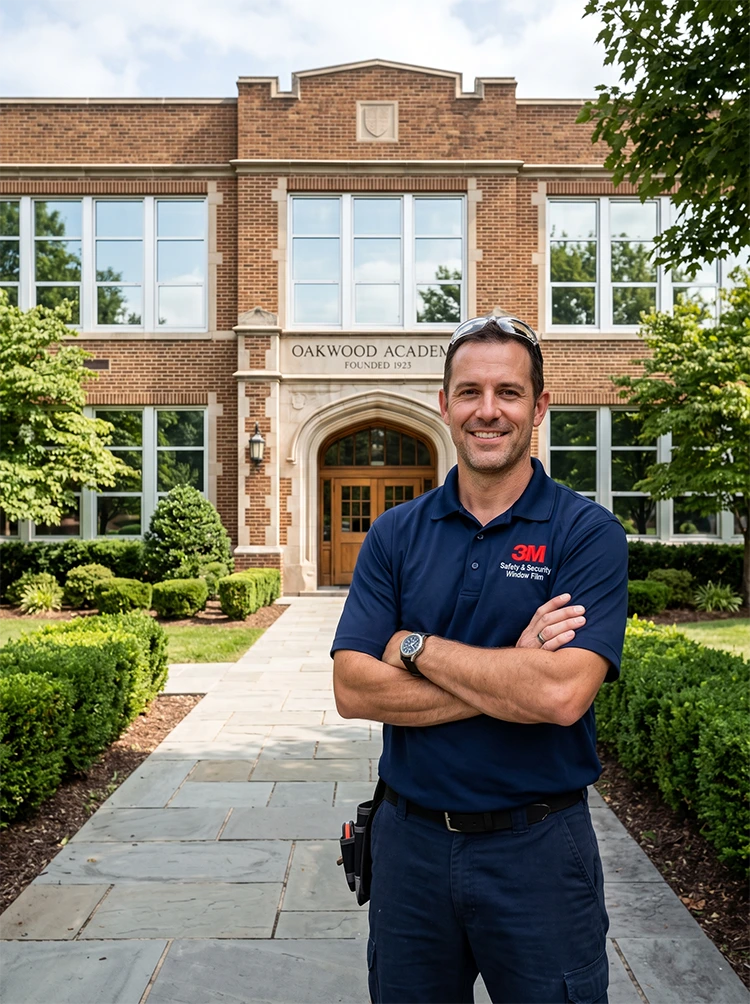
Security window film is a thick, optically clear polyester layer bonded to the interior face of your existing glass. When glass breaks, the film holds the fragments together in the frame instead of letting them fall inward, which slows a forced entry and prevents most glass-related injuries.
Unlike decorative film, safety and security window film is measured in mil, a unit equal to one one-thousandth of an inch. 3M Scotchshield security films run 4 to 15 mil (3M product data), and thickness is the single biggest driver of both performance and price.
One limit is worth stating up front: security film is shatter-resistant, not bulletproof. It holds glass in the frame and buys time. A bullet still passes through the material. What real ballistic protection costs is covered below.
What Changes Your Security Window Film Cost
Two projects with the same square footage can price very differently.
Thickness does most of the work. A 4 to 8 mil film costs less and delivers basic shatter resistance, while a 12 to 15 mil film costs more and resists sustained forced entry. We price by measured glass area rather than by window count, so a house with two large sliding doors can cost more than a house with eight small windows.
The other big variable is whether you add a frame attachment system. Film alone holds the glass together. An attachment system holds the glazing to the frame, which is what forced-entry criteria are written around, and it adds roughly $3 to $5 per square foot. See how attachment systems work and our impact protection attachment systems.
Four things then adjust the estimate up or down:
- Window shape and access. Arched, divided, or hard-to-reach glass takes longer to template and install.
- Glass condition. Failing seals, cracks, or deteriorating frames need attention before film goes on, and we flag that during the survey rather than after the invoice.
- Which openings you cover. Ground-floor doors, sidelights, and accessible windows carry the highest risk and usually justify the thickest film. Upper stories often do not.
- Labor rates where you are, which vary across our service area.
Cost by Film Grade and Thickness
|
Film grade |
Thickness |
Estimated cost per sq ft installed |
|---|---|---|
|
Basic |
4 to 8 mil |
$8 to $10 |
|
Mid-range |
8 to 12 mil |
$10 to $13 |
|
Premium |
12 to 15 mil |
$13 to $15 |
|
Add-on: frame attachment system |
n/a |
Add $3 to $5 |
For a whole-home project, most clients land in one of three packages. The figures below assume roughly 15 windows on a 3-bedroom home:
|
Package |
What it includes |
Total estimated cost |
|---|---|---|
|
Basic security film |
Standard shatter resistance |
$1,500 to $2,500 |
|
Mid-range security film |
Enhanced thickness and durability |
$2,500 to $3,500 |
|
Premium security film |
Premium film plus frame attachment system |
$3,500 to $4,500+ |
Security Film Cost for Schools and Universities
Schools and universities price differently from homes, because the work is bid by volume and has to satisfy criteria that a residential job never touches.
Volume Pricing Tiers
|
Project scope |
Estimated square footage |
Target installed rate |
|---|---|---|
|
High-risk entry points only |
Under 1,000 sq ft |
$12 to $15 per sq ft |
|
Individual building or wing |
1,000 to 5,000 sq ft |
$9 to $12 per sq ft |
|
District-wide or full campus |
5,000+ sq ft |
$7 to $9 per sq ft |
These rates include professional installation and the high-tensile attachment systems that forced-entry criteria generally require. Smaller scopes cost more per square foot because mobilization and templating are fixed costs spread across less area.
Standards and Documentation
Security glazing performance is evaluated against published ASTM test standards, not marketing language. Two matter most for institutional work:
- ASTM F1233, the standard test method for security glazing materials and systems, which measures resistance to repeated physical attack.
- ASTM E2395, the standard specification for window film attachment systems, which is what determines whether the glazing stays in the opening under load.
Forced-entry performance depends on the whole assembly: the glass, the film thickness, the attachment method, and the tool used against it. We will provide the specific test documentation for the products we propose so your safety audit or grant reimbursement file has what it needs.
Many districts fund this work through state and federal school safety grant programs. Our documentation package is built to support the shatter-resistant and forced-entry criteria those programs ask for.
A Tiered Approach to Campus Glass
Covering every pane is rarely the best use of a safety budget. We usually recommend three tiers:
- Tier 1, high risk. Ground-floor entry doors and adjacent sidelights, with premium film plus mechanical attachment.
- Tier 2, internal. Classroom door glass and interior hallway glazing.
- Tier 3, perimeter. Standard ground-floor windows with 8 mil film for baseline shatter resistance.
More on this work: school window film upgrades in Baltimore, security film for school safety, and GSA-compliant security film for federal facilities. GSA is the General Services Administration, whose compliance standards apply to federal building work.
Security Film Cost for Commercial and Retail Properties
Commercial pricing follows the same per-square-foot logic as residential, with a few differences that show up in the total.

Storefront glass is larger, so material cost per opening is higher while labor per square foot often drops. Scheduling matters more. Most retail and office work happens after hours or in phases to keep the space trading, and we build that into the schedule rather than the hourly rate. Risk also tends to be concentrated: entry doors, ground-floor display glass, and cash-handling areas justify premium film while upper floors do not need it.
For general contractors and facility managers bidding a project, we provide line-item pricing by elevation, product data sheets, warranty terms, and a single point of contact through the job. See commercial window film, security film for Baltimore retailers, and government and institutional window film.
Is Security Film Cheaper Than Replacing the Glass?
Yes, in nearly every case. This is the comparison most buyers are weighing, so here are the tiers side by side.
|
Approach |
Estimated cost |
What you get |
|---|---|---|
|
Security window film on existing glass |
$8 to $15 per sq ft |
Shatter resistance, glass retained in frame, no construction |
|
Film plus attachment system |
$11 to $20 per sq ft |
Above, plus the glazing anchored to the frame |
|
Full window replacement |
Several times the cost of film |
New unit, new frame work, interior disruption |
|
Rated ballistic or blast assembly |
Highest cost tier |
Tested protection against specific threats |
Film upgrades what you already own without touching the frame, the trim, or the interior finish. Replacement makes better sense when the window is already failing or when you need a rated assembly that film cannot deliver. We walk through the full math on our safety glazing versus replacing glass cost analysis.
Security film also preserves the view and the daylight, which security bars and shutters do not. And it keeps working on the days nobody is thinking about security. It holds glass together during a storm. Films like 3M Night Vision add heat and glare control and block up to 99.9% of ultraviolet (UV) rays (3M product data), the rays that fade floors and furnishings.
What “Bulletproof” Window Film Really Costs
This is the pricing question we get asked most often, and the honest answer disappoints people.
No window film is bulletproof. There is no price for it, because the product does not exist. Any installer quoting you bulletproof film is selling you something else. Here is what does exist.
Security window film is a high-tensile polyester layer that holds glass shards together on impact. It is shatter-resistant, which means the glass stays in the frame and an intruder has to keep working. A bullet passes through it. This is the right product for smash-and-grab prevention, storm damage, and forced-entry delay. Read more on shatter-proof versus shatter-resistant.
Bullet-resistant systems are rated assemblies tested under UL 752 or National Institute of Justice standards against specific ammunition. Achieving a rating generally means replacing the glazing with multi-layer polycarbonate laminates, or structurally treating the existing glass with a glass-strengthening system such as C-Bond. See C-Bond bullet-resistant windows for how that works and what it involves.
In practice, people asking about bulletproof film want one of two things. If you want the most delay film can give you, that is a 14 mil security film with a wet-glaze attachment system, about $12 to $18 per square foot installed. It is the strongest thing film can do, and it still is not ballistic-rated. If you need actual ballistic resistance, you need a rated system priced per project after a threat assessment, and you should budget for glass treatment or replacement plus reinforced framing rather than for film.
Professional installers use the term bullet resistant, never bulletproof, and always with the standard and threat level attached. If a quote does not name a standard, it is not rated.
Security Window Film Cost in Newark, Wilmington, Baltimore, and Washington DC
The ranges on this page hold across our service area, but what a project looks like on the ground changes by market.
Newark and Wilmington, Delaware. Our home market since 1989. New Castle County residential work sits in the middle of the ranges above, and we cover residential, commercial, government, and automotive services here. See window tinting in Newark, DE.
Baltimore, Maryland. Retail and commercial security film is the bulk of our Baltimore work, particularly ground-floor storefront glass and school facilities. City access and parking can add mobilization time on tight urban blocks. See window film in Baltimore, MD. Note that automotive tinting is not offered in Baltimore.
Washington DC. Government, institutional, and commercial projects, where GSA-compliant products and documentation usually drive the specification more than the per-square-foot rate.
Broader Mid-Atlantic. We also serve Eastern Maryland, Pennsylvania, and New Jersey. Automotive window tinting and paint protection film are offered in Delaware only.
Long-Term Value, Warranty, and Maintenance
Security film is a durable improvement, not a consumable. Professionally installed interior film lasts many years, and 3M films carry a manufacturer warranty on the film itself. Terms vary by product and application, so we confirm the exact coverage in writing with your estimate and register the warranty when the job is done. See 3M warranty information.
Maintenance is minimal: a soft cloth, a non-abrasive cleaner, and the manufacturer care guide that ships with your warranty documents.
On insurance, some carriers consider glass and security upgrades when pricing a policy. Ask your agent whether security film qualifies for a credit on your specific policy before you count it in your payback math.
How to Choose a Security Film Installer
The film matters. The installation matters more. Even the best film underperforms if it is applied to unprepared glass or paired with the wrong attachment method.
Start with certification, and mean the real thing: a manufacturer dealer certification, not a logo dropped on a website. We are the only Premier 3M Certified Dealer in New Castle County and the surrounding areas, which is 3M’s highest dealer tier and the reason we can register the full manufacturer warranty.
Then ask about security work specifically. Sun control film and forced-entry film are different disciplines, so ask how many attachment systems the installer has actually specified. Ask for the paperwork too: product data sheets, test standards, warranty terms, and a written scope. Institutional buyers should expect a bid-ready package rather than a number in an email.
A quote produced without measuring your glass is a guess. And you can check a track record before you spend anything, so read what our clients say.
Be careful with quotes far below the ranges on this page. They usually mean thinner film than specified, no attachment system, or an installer who will not be around to honor a warranty. We have been doing this in the Mid-Atlantic since 1989, over 35 years, and we would rather explain our pricing than discount our way into a job we cannot stand behind.
Get Your Security Window Film Estimate
Every quote on this page is an estimate until we measure your glass. A site survey takes one visit, and you get a written, line-item number with the film specification, the attachment method, the warranty terms, and the schedule.
Professional Window Tinting has installed window film across Delaware, Maryland, and Washington DC since 1989, over 35 years. We are woman-owned, and we are the only Premier 3M Certified Dealer in New Castle County and the surrounding areas.
Request a quote and we will tell you exactly what your project costs, including whether film is the right answer for the risk you are trying to solve.